
IMEI Registration, Import Taxes, and Indonesian SIM Cards

If you’re planning to travel or move to Indonesia, it’s important to understand how IMEI registration, import taxes, and SIM card regulations work. These rules help control mobile phone usage and protect against illegal imports — but for travelers, they can be confusing.
This guide breaks it all down in an easy way, so you can stay connected legally and avoid any unexpected issues with your phone or data plan in Indonesia.
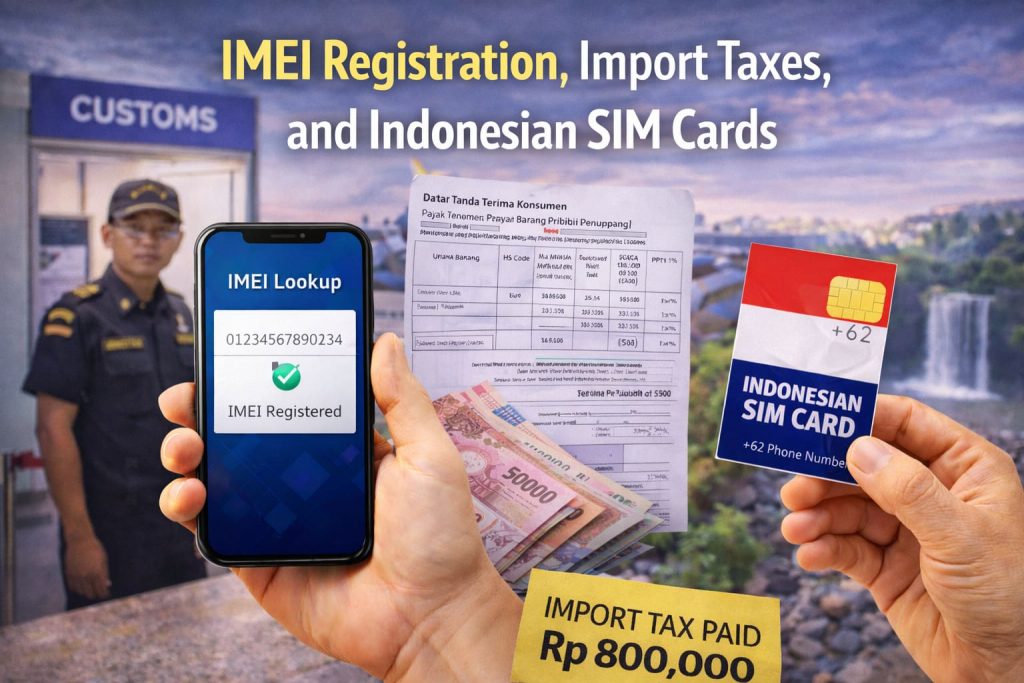
Table of Contents
I. What Is an IMEI and Why Does It Matter?
IMEI stands for International Mobile Equipment Identity — a unique 15‑digit code assigned to every mobile phone. Indonesian authorities use IMEI numbers to identify, track, and validate all devices connected to local networks.
In simple terms: If your smartphone’s IMEI is not registered in Indonesia, the local mobile networks (Telkomsel, XL, Indosat, etc.) may block its cellular connection. That means you won’t be able to use a local SIM card for calls or Internet.
This makes IMEI registration especially important if you’re bringing your own phone from another country.
II. Who Needs to Register Their IMEI in Indonesia
There are two main categories:
1. Short‑Term Travelers
If you’re visiting for a short stay (less than 90 days):
- You do not need to register your IMEI at the customs office.
- You can still use a local or international eSIM for the mobile Internet.
- Your phone will remain temporarily connected through local networks.
2. Long‑Term Visitors or New Residents
If you plan to stay longer than 90 days or move permanently:
- You must register your IMEI with Indonesian customs upon arrival.
- This ensures your imported device can continue connecting to mobile networks after the grace period.
- If not registered, your phone might lose cellular access after three months.
III. How to Register Your IMEI in Indonesia
You can register your IMEI at the airport or online via the official BeaCukai (Indonesian Customs) website.
Step‑by‑Step Guide:
- Go to https://www.beacukai.go.id/ before or upon arrival.
- Fill out the IMEI registration form (Customs Declaration for Mobile Devices).
- Provide details like brand, model, and IMEI number (check under Settings → About Phone).
- Present your passport and boarding pass to customs officers (if registering at the airport).
- For phones worth above USD 500, import taxes may apply before activation.
After registration, the system updates your phone’s IMEI with Indonesia’s national database, allowing you to use local networks indefinitely.
IV. Import Tax Rules for Mobile Devices
Travelers are allowed to bring one or two personal phone duty‑free, as long as the combined declared value is under USD 500.
If your phone is valued above that:
- You’ll need to pay an import tax, typically around 10–15 % based on the phone value.
- Payment can be done directly at the airport customs counter or via their online payment system.
- Once cleared, you’ll receive a customs approval slip for IMEI registration.
Pro Tip:
Always keep your purchase invoice or receipt if you buy your device abroad. It helps avoid overestimated tax charges at inspection.
V. Using Local SIM Cards in Indonesia
Once your IMEI is registered (or if you’re staying short‑term), you can freely use a local SIM card. Indonesia has three main network providers:
- Telkomsel – best coverage across all islands
- XL Axiata – strong in urban and suburban areas
- Indosat Ooredoo – good for cost‑effective data plans
Buying a SIM Card
- You’ll need to show your passport for registration.
- Available at airports, convenience stores, or official outlets.
- Most prepaid SIM cards come with data + call bundles.
SIM cards for tourists generally last 30 days and can be topped up easily via apps or vouchers.
VI. eSIMs: A Simpler Alternative for Short Stays
If you prefer skipping physical SIM cards and long registration lines, you can use an eSIM (digital SIM) instead.
eSIMs allow you to connect instantly upon landing — simply scan a QR code, and you’re online in seconds.
Reliable options like [https://indonesiaesim.com/] offer prepaid plans starting at $2.90, available nationwide with Telkomsel’s 99 % coverage. This is a good choice if you’re:
- Traveling across multiple Indonesian islands
- Avoiding IMEI registration for short stays
- Wanting to save time at the airport
All plans include 4G LTE speeds and 24/7 support.
VII. Common Issues and FAQs
What if I didn’t register my IMEI and my SIM stops working? Your device may be blocked from Indonesian cellular networks after 90 days. You can still use Wi‑Fi or contact customers to register retroactively (tax may apply).
Do I need to register if I buy a phone in Indonesia? No, local devices are already registered by default.
Can I use my eSIM without IMEI registration? Yes, for temporary stays (under 90 days), you can use an eSIM like those from [https://indonesiaesim.com/].
Are dual‑SIM phones affected? Only the hardware IMEI is registered — not the SIM card. If one SIM slot is disabled by networks, both may be affected.
Does IMEI registration apply to tablets or laptops? Yes, data‑enabled devices (LTE or 5G) fall under the same rule.
If you’re heading to Gili Trawangan or Lombok, chances are you’ll want constant access to WhatsApp, maps, and quick uploads of those beach sunsets. But, island Internet in Indonesia can be hit or miss — and that’s exactly where a good eSIM makes a world of difference. In this 2026 guide, you’ll find out which […]
If you use WhatsApp daily for calls, messages, or client chats — you already know how important stable data is. But what if you want to keep WhatsApp active on a secondary phone, just for communication while abroad? In 2026, the easiest, most cost‑effective way to stay connected is with an eSIM plan — especially […]
So, you’re planning a trip to Bali, Jakarta, or Lombok — but you haven’t arrived yet. You want to stay connected right when you land, without hunting for SIM shops or juggling roaming fees. Good news: in 2026, you can get your Indonesia eSIM entirely online — even if you’re not in the country yet. […]
Whether you’re exploring Bali’s rice terraces, hopping between coworking cafés in Canggu, or navigating the winding streets of Ubud, having strong, consistent Internet is essential. For many travelers and remote workers, the biggest question is: Which eSIM actually delivers stable data for video calls, navigation, and daily connectivity in Bali? Let’s take a detailed look […]
As eSIM technology becomes more common in Southeast Asia, many travelers and residents are asking: Can I use multiple eSIMs in Indonesia? Yes — you can. Most modern smartphones now support multiple eSIM profiles, which means you can switch between different data plans and mobile networks without needing extra SIM cards. In this practical guide, […]
When preparing for an international trip, staying connected to the Internet is one of the most important things to plan. Travelers often face a common question: Should I use portable WiFi or an eSIM for international travel? Both options keep you online, but they work differently. Let’s explore how each one functions, their pros and […]